Skip to content
(619) 722-8555 7am - 4pm PST, M-F

Your cart is empty

Have an account? Log in to check out faster.

Continue shopping
Comparing Fox, King and Ride Shocks for the 2024+ Toyota Tacoma

Comparing Fox, King and Ride Shocks for the 2024+ Toyota Tacoma

July 6, 2026

How do Ride Shocks measure up against Fox and King Shocks?

For this article, we will be comparing similar 2024+ Toyota Tacoma Shocks.


Since 1996, King Shocks has been one of the most respected names in off-road suspension. Family-owned and operated, every King shock is engineered, machined, assembled, and rebuilt in the USA. Known for their iconic blue anodized finish and race-proven performance, King products are trusted by professional race teams, weekend warriors, and overlanders alike. Whether tackling high-speed desert terrain or technical rock trails, King Shocks have built a reputation for exceptional durability, consistent performance, and precise suspension control.

Fox Shocks has long been one of the most recognized names in off-road suspension, offering performance shock absorbers for trucks, SUVs, UTVs, race vehicles, and a wide range of OEM applications. Today, Fox products are found on vehicles like the Ford Raptor, Ford Bronco, Jeep Wrangler Rubicon, Toyota Tacoma TRD Pro, Toyota 4Runner TRD Pro, and Chevrolet Colorado ZR2, while also powering countless custom off-road and overland builds. From daily-driven trucks to high-speed desert racers, Fox has earned a reputation for delivering proven performance, durability, and control in demanding conditions.

Ride Shocks are designed, engineered, tuned, tested, and assembled by the suspension specialists at AccuTune Offroad in San Diego, California. Developed from nearly two decades of experience tuning and servicing off-road suspension systems, Ride Shocks were built to deliver premium performance without compromise. Every shock is application-specific, tuned for the vehicle’s weight and intended use, and backed by modern features like the patented Dual Piston Adjuster (DPA). While Ride Shocks is a newer name in the industry, it’s built on years of real-world suspension expertise and feedback from thousands of customers and countless miles of off-road testing.

FRONT SHOCKS
King Shocks Tacoma 2.5 Coilovers

SKU: KRS-25001-408A
Extended Length: 25.13″
Compressed Length: 18.72″
Travel: 6.41″

FRONT SHOCKS
Fox Shocks Tacoma 2.5 Coilovers

SKU: FOX-883-06-224
Extended Length: 25.08″
Compressed Length: 18.61″
Travel: 6.47″

FRONT SHOCKS
Ride Shocks Tacoma 2.5 Coilovers

SKU: 525417389, 525417489
Extended Length: 25.34″
Compressed Length: 19.25″
Travel: 6.09″

REAR SHOCKS
King Shocks Tacoma 2.5 Coilovers

SKU: KRS-25001-409A
Extended Length: 27.28″
Compressed Length: 18.00″
Travel: 9.29″

REAR SHOCKS
Fox Shocks Tacoma 2.5 Shocks

SKU: FOX-883-06-143
Extended Length: 26.28″
Compressed Length: 16.30″
Travel: 9.98″

REAR SHOCKS
Ride Shocks Tacoma 2.5 Coilovers

SKU: 525417589, 525417689, 525417789, 525417889
Extended Length: 27.06″
Compressed Length: 17.28″
Travel: 9.79″

Bodies/Shafts Wrap Up

Shock body material plays an important role in durability, corrosion resistance, and heat management. Aluminum shock bodies are lightweight, naturally corrosion resistant, and dissipate heat more efficiently than steel, helping maintain consistent damping performance during extended off-road use. Steel bodies offer exceptional strength and durability but rely on protective coatings or plating to prevent corrosion.

FOX and Ride Shocks both feature hard-anodized 6061-T6 aluminum shock bodies. The hard-anodized finish becomes part of the aluminum itself, providing excellent wear and corrosion resistance without the risk of paint or powder coat flaking. While the finish may fade over time from UV exposure and trail use, it continues to protect the shock body for years.

King Shocks utilize cadmium-plated steel shock bodies. The steel construction provides outstanding strength, while the cadmium plating offers excellent corrosion protection in harsh environments. Like anodizing, cadmium plating is a proven finish for off-road applications and has been used by King for decades. Ultimately, the choice between aluminum and steel comes down to each manufacturer’s design philosophy, balancing factors like weight, heat dissipation, serviceability, and aesthetics.

King Shocks 2.5 Coilover lower rod end assembly
Fox 2.5 Coilover lower rod end assembly
Ride Shocks 2.5 Coilover lower rod end assembly
King Shocks 2.5 smooth body lower rod end assembly
Fox Shocks 2.5 smooth body lower rod end assembly
Ride Shocks 2.5 smooth body lower rod end assembly

Front / Rear Rod Ends Wrap Up:

FRONTS:
All three brands use a similar lower mount design consisting of a CNC-machined aluminum rod end that houses a spherical bearing to connect the coilover to the lower control arm. It’s a simple, proven design that offers excellent strength, articulation, and serviceability.

The quality of the spherical bearing, however, plays a significant role in long-term durability and noise performance. As bearings wear, they can develop play that leads to unwanted clunks or squeaks in the front suspension. FOX and Ride Shocks use premium FK Rod Ends spherical bearings manufactured in the USA, which are widely regarded as some of the highest-quality bearings available for off-road suspension. King uses a more economical bearing, which helps reduce manufacturing costs but may not offer the same longevity under demanding conditions.

To help maximize bearing life, all three manufacturers incorporate protective seals or wipers around the spherical bearing to keep dirt, water, and debris from accelerating wear.

REARS:

All three brands use a similar lower rear shock mount on the 2024+ Toyota Tacoma, utilizing a rubber bushing to connect the shock to the axle. This style of mount provides excellent durability while allowing enough compliance to isolate noise and vibration, making it well suited for both daily driving and off-road use.

One distinguishing feature of the King rear shock design is the CNC-machined lower rod end, which includes a precision-machined groove that integrates a plastic shaft guard. Unlike add-on accessories, this shaft guard is included with the shock and is designed to protect the exposed shock shaft from rocks, sand, and debris thrown by the front tires during off-road driving, helping improve long-term shaft durability in harsh conditions.

2024+ Tacoma King 2.5 Coilover Shock
2024+ Tacoma Fox 2.5 Coilover Shock
2024+ Tacoma Ride Shocks 2.5 Coilover

Front Coil Springs Wrap Up:

Coil springs play a critical role in the front suspension performance of the 2024+ Toyota Tacoma. Spring length, diameter, and rate all directly influence how well the suspension supports the vehicle’s sprung weight. No two Tacoma’s are exactly the same, Toyota produces multiple trims with varying curb weights, and the addition of the new hybrid powertrain further increases front-end weight compared to traditional gas models. As a result, Toyota itself uses different factory spring specifications depending on configuration.

With that in mind, FOX and King offer a single front coilover spring rate for their 2.5-inch coilover applications. While these shocks are marketed as “application-specific” and will physically fit all 4th Gen Tacoma models, the spring rates are not differentiated based on trim level, drivetrain, or vehicle weight. When spring rate is generalized, damping (valving) is also generally standardized rather than optimized for each configuration.

Ride Shocks takes a more weight specific approach by offering multiple front coilover options for the 4th Gen Tacoma. This allows the suspension to be properly matched to a wide range of builds from stock trucks to heavily modified overland rigs helping ensure correct ride height consistent control and predictable performance regardless of trim level or added accessories.

By providing application specific configurations from the start Ride Shocks enables Tacoma owners to select a setup that fits their exact vehicle weight and intended use without the need for aftermarket spring changes or internal valving adjustments after installation.

Ride Shocks piston for 2024 and new Tacoma shocks.
Ride Shocks come standard with 5/8" fittings and hoses
Reservoir hose size detail comparison between Fox, King and Ride Shocks

Oil Flow Wrap Up:

Oil flow is a critical factor in how comfortable and tunable a shock feels. When oil flow is restricted, the suspension can feel harsh during rapid, repetitive inputs such as washboard roads, rough pavement, and choppy ruts. Limited flow can also contribute to increased stiffness and impact harshness over larger obstacles like speed bumps and desert whoops.

FOX and King typically use a -8 (1/2 inch) hose size, which is the industry standard for most OEM-style applications in this category. Ride Shocks uses a -10 (5/8 inch) hose, which is the largest commonly used size for these applications, allowing for increased oil flow capacity and improved potential for consistent damping under demanding conditions.

King Shock oil
Fox Shock oil for shocks
Ride Shock oil

Oil Wrap Up:

Shock oil performance is evaluated using several key factors, including lubrication quality, viscosity stability across temperature changes, and resistance to boiling and cavitation.

All three brands use high quality oils that provide effective lubrication, are compatible with common seal materials, and perform well under normal operating conditions. The differences become more apparent as shock temperatures increase during sustained off road use.

Shock fade occurs when heat causes the oil to thin, reducing damping force and overall suspension control while also increasing wear on internal components. Viscosity index measures how stable an oil remains as temperatures rise. A higher viscosity index indicates better stability. A value around 400 is considered excellent, while around 100 is considered below average. FOX uses an industry benchmark oil with a viscosity index of approximately 375. King’s oil is closer to the mid range at around 150. Ride Shocks also uses a high performance oil with a viscosity index of approximately 375.

Cavitation occurs when shock oil reaches its boiling point and forms air bubbles, which reduces damping performance and can contribute to internal wear. FOX oil has a boiling point of approximately 496 degrees Fahrenheit, King oil is around 320 degrees Fahrenheit, and Ride Shocks oil is approximately 615 degrees Fahrenheit. These values are measured at atmospheric pressure, and real world operating conditions can vary, especially since shock systems do not always maintain constant positive pressure.

FOX JM92 oil has long been considered an industry standard for high performance shock applications due to its consistency and thermal stability. Ride Shocks uses a newer fully synthetic oil blend designed to match high resistance to fade while offering improved resistance to cavitation and higher overall thermal limits.

King Shocks mid speed adjuster
Fox Shocks DSC Evo adjuster
Ride Shocks DPA adjuster

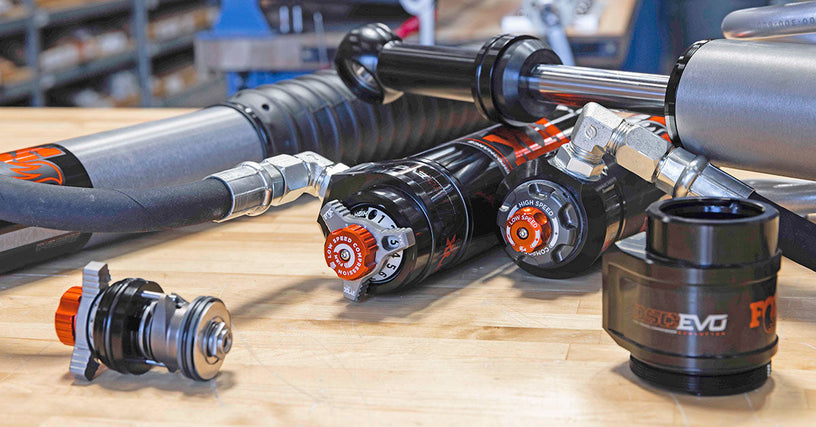
The Fox DSC EVO (Dual Speed Compression Evolution) adjuster is an external tuning system that provides independent control over low-speed and high-speed compression on select Fox 2.5 shocks.

Low-speed compression is adjusted through a bleed circuit that meters oil flow and primarily affects chassis movements like brake dive, body roll, and acceleration squat. High-speed compression is controlled through a separate valve circuit that responds to rapid shaft movements such as potholes, rocks, and whoops.

The DSC EVO design improves upon previous versions by incorporating Fox’s Variable Valve Control (VVC) technology on the high-speed circuit. Instead of relying only on added preload, VVC changes the mechanical leverage applied within the valve assembly, allowing more separation between low-speed comfort tuning and high-speed impact control.

The result is a broader, more usable adjustment range where low-speed settings maintain ride quality while high-speed adjustments more directly influence harsh impacts and bottom-out resistance.

Tech Article: Fox DSC vs DSC Evo [Click to learn more]

The mid speed adjuster on King Shocks operates as a large adjustable bleed circuit that regulates how much oil can bypass the piston as the adjuster is turned. In practical terms, it functions as an expanded version of a low speed compression adjuster, influencing a broader range of shaft movement than a traditional bleed circuit.

When the adjuster is fully open, oil flows more freely through the circuit, resulting in a softer and more compliant feel. As it is closed, oil flow is progressively restricted, increasing compression damping and firming up the suspension response under load.

Learn more about how the King Adjuster works 

The Ride Shocks Dual Piston Adjuster (DPA) incorporates a patented design that provides independent control over low speed and high speed compression circuits within a single adjuster system.

At low shaft speeds, oil flows through an adjustable needle and seat bleed circuit, allowing a controlled amount of oil to bypass into the reservoir. This primarily influences chassis movement such as body roll, braking, and acceleration.

As shaft speed increases, oil begins flowing through the first piston circuit. From there, it can pass through the high speed adjuster circuit, which further regulates flow depending on the selected setting.

When the high speed circuit is adjusted toward a firmer setting, oil is progressively restricted from bypassing through the primary path and is instead directed through a secondary piston. This increases high speed compression damping and improves control during rapid suspension movements such as sharp impacts, whoops, and rough terrain.

Learn more about the DPA adjuster here

Adjusters Wrap Up:

Compression adjusters play a major role in ride quality by allowing external tuning to account for added vehicle weight, different terrain types, and changing driving conditions.

Low speed compression refers to slower shock shaft movements associated with cornering, braking, acceleration, and gradual suspension loading such as rolling terrain. Adjustments in this range primarily affect body control, steering response, and overall chassis feel.

High speed compression occurs during rapid shaft movements caused by sharp impacts like rocks, potholes, speed bumps, and whoops. These events require the shock to move quickly, making high speed damping critical for impact control and bottom out resistance.

Fox DSC EVO adjusters separates these functions into independent low speed and high speed circuits. Low speed compression is controlled through a bleed style adjuster that influences chassis movement and small bump behavior. High speed compression is controlled through a dedicated valve circuit that uses Fox’s Variable Valve Control technology to improve separation between comfort tuning and impact control. This allows more precise tuning between ride quality and large impact resistance.

King compression adjusters use a simpler mid speed bleed style design that influences a wider range of shaft speeds through a single adjustment point. This approach is straightforward and effective, offering usable tuning for both everyday driving and moderate off road conditions, but with less separation between low speed comfort and high speed impact control compared to dual circuit systems.

Ride Shocks DPA adjusters use a patented dual piston design that separates low speed and high speed oil flow paths within a single integrated system. At low shaft speeds, a bleed circuit manages chassis movement. As shaft speed increases, oil is progressively routed through additional piston stages and adjuster circuits. This design maintains strong low speed control while allowing high speed events to bypass or transition through a separate flow path, providing a more linear and predictable adjustment range across a wide variety of driving conditions.

Seals Wrap Up:

Seal design is a critical factor in the long term durability and performance of Toyota Tacoma suspension systems, especially on high performance setups like FOX, King, and Ride Shocks coilovers and rear shocks. Each manufacturer invests heavily in their seal packages, and while the designs differ, they are all aimed at balancing low friction movement with long term oil retention and contamination resistance.

Based on years of servicing 3rd Gen and 4th Gen Tacoma suspension systems, including lifted Tacoma builds and overland applications, dirt intrusion consistently ranks as the second most common cause of shock leakage and premature wear. External contamination entering the seal head accelerates wear and can lead to performance loss over time, especially in dusty off road environments.

Shock boots remain one of the most effective forms of protection for Tacoma shocks, helping shield the shaft and seal area from direct exposure to dirt, sand, and debris. This is often paired with multiple wiper seals that help scrape contamination away before it reaches the primary sealing surface.

Material selection also plays an important role in seal life. HNBR seals offer improved heat resistance and durability compared to standard NBR, making them better suited for the increased temperatures seen in aggressive off road Tacoma suspension use. For oil retention, U cup seal designs provide strong sealing force across a wide range of shaft speeds and temperatures, and generally outperform traditional O ring style seals in dynamic suspension applications.

Together, these design choices directly influence how well a Tacoma suspension system maintains performance, reduces noise, and resists leaks over time in real world driving conditions.

Valving Wrap Up:

As mentioned earlier, the 2024+ Toyota Tacoma lineup includes several trim levels with different front axle weights, most notably the hybrid models, which carry significantly more weight than their gasoline counterparts. For any Tacoma suspension to perform at its best, the shock valving must be properly matched to the spring rate and the vehicle’s sprung weight. When the spring and valving are not balanced, ride quality and handling suffer, resulting in a suspension that can feel overly harsh, excessively soft, or lacking in overall control.

Toyota recognizes these weight differences by equipping hybrid and non hybrid Tacomas with different factory springs and shock tuning. The same principle applies to aftermarket Tacoma suspension systems. A one size fits all approach may physically fit every truck, but it cannot deliver optimal performance across every configuration.

Ride Shocks addresses this by offering multiple pre tuned suspension options for the 2024+ Toyota Tacoma. Each option is designed around a specific vehicle weight range, allowing owners to choose a setup that matches their truck whether it is completely stock or equipped with heavier accessories like steel bumpers, a winch, skid plates, roof rack, or rooftop tent. This application specific approach provides the correct spring rate and internal valving right out of the box, eliminating the need for additional spring swaps or revalving.

FOX and King currently offer a single spring rate and valving configuration for their 2.5 inch Tacoma coilovers. While these products are compatible with the entire 2024+ Tacoma platform, it is unclear which vehicle configuration they were tuned around, and neither specifically identifies a version optimized for the added weight of hybrid models. As a result, some Tacoma owners, particularly those with hybrid trucks or heavily equipped overland builds, may benefit from custom spring and valving changes to fully optimize ride quality and suspension performance.

King Shocks with compression adjusters custom tuned by AccuTune Offroad for 2024 or newer Toyota Tacoma.
2024 Tacoma Fox 2.5 shocks front and rear custom tuned with DSC EVO adjusters
Ride Shocks kit for 4th Gen Tacoma

Appearance Wrap Up:

Performance should always be the top priority when choosing a suspension system, but appearance is part of the decision for many Tacoma owners. FOX, King, and Ride Shocks have each created a distinctive design that is instantly recognizable in the off road community. FOX is known for its black and orange color scheme, King for its signature blue anodized finish, and Ride Shocks for its bold red, black, and gray design. Each offers a premium look that complements the 2024+ Toyota Tacoma while reflecting the brand’s unique identity.

When it comes to appearance, there is no clear winner. It ultimately comes down to personal preference. Which shock design looks best on your Tacoma?

King Shocks rebuild kit
Fox Shocks rebuild kit
Ride Shocks rebuild kit includes new seals and o-rings

Rebuild/Service Wrap Up:

Like any high performance Toyota Tacoma suspension, rebuildable shocks require periodic service to maintain peak performance. When comparing suspension options, it’s important to consider recommended service intervals, rebuild costs, and long term parts availability, as these factors all contribute to the overall cost of ownership.

FOX, King, and Ride Shocks are very similar in this regard. All three recommend servicing their shocks at approximately 50,000 miles under normal driving conditions, which typically includes daily driving with occasional off road use. However, actual service intervals depend heavily on how the truck is used. Tacoma owners who frequently drive rough trails, washboard roads, or high speed desert terrain may need to rebuild their shocks well before 50,000 miles. On the other hand, trucks that spend most of their time on pavement can often exceed the recommended interval while continuing to perform well.

Ultimately, suspension maintenance should be based on vehicle usage rather than mileage alone. Regular inspections and timely rebuilds help maximize ride quality, extend component life, and ensure consistent performance on and off the trail.

Warranty:

Warranty coverage is another important factor to consider when investing in a premium Toyota Tacoma suspension system. While warranties don’t necessarily predict reliability, they do reflect the manufacturer’s confidence in their product and provide added peace of mind.

FOX Shocks are backed by a 1 year limited warranty, while King Shocks include a 90 day limited warranty. Ride Shocks offer the longest coverage of the three with a 3 year or 50,000 mile warranty, providing Tacoma owners with additional long term protection and confidence in their suspension investment.

King installation guide for 4th gen Tacoma shocks
Fox installation guide for 4th gen Tacoma shocks
Ride Shocks installation guide for 4th gen Tacoma

Install Guides Wrap Up:

A well written installation guide can make installing a new Toyota Tacoma suspension much easier, whether you’re a professional installer or tackling the job yourself. The best guides include clear instructions, detailed images, and all the information needed to complete the installation correctly without searching for additional resources.

FOX provides thorough, easy to follow installation manuals that have long set the industry standard. King builds on this with detailed step by step instructions and full color images. Ride Shocks offers similarly comprehensive guides while also including suspension setup and adjustment information to help owners get the best performance from their new suspension after installation.

Ride Shocks takes this a step further with guides that are both comprehensive and practical. In addition to covering installation, they provide extensive suspension setup information, allowing users to fine-tune their shocks for optimal performance.

Ultimately, the quality of an installation guide can make a huge difference in the ease and success of your shock installation. Before buying, it’s worth reviewing the guide to ensure you’re confident in your choice.

Final Wrap Up:

Choosing the best suspension for your 2024+ Toyota Tacoma involves much more than comparing brand names. Shock body materials, compression adjusters, spring rates, valving, oil quality, seal design, bearings, hose size, serviceability, warranty, and installation support all play an important role in how a suspension performs and holds up over time.

FOX, King, and Ride Shocks each bring their own strengths to the table. FOX offers decades of proven performance and advanced DSC EVO adjuster technology. King is known for its race proven durability, simple tuning philosophy, and legendary reputation in the off road community. Ride Shocks combines modern engineering with application specific spring rates and valving, a patented Dual Piston Adjuster, premium components, and the longest warranty of the three.

Ultimately, the best Toyota Tacoma suspension is the one that matches your truck, your driving style, and your future plans. Whether you prioritize daily driving comfort, overland capability, or high speed off road performance, understanding the engineering behind each system will help you make an informed investment and get the most out of your Tacoma.

4th Gen Tacoma Suspension Frequently Asked Questions

Which shocks ride better: Fox, King, or Ride?

There isn’t a single shock that rides best for every Tacoma. Ride quality depends on your vehicle’s weight, how you use it, and how the shocks are tuned. A stock daily driver has very different suspension needs than an overland build carrying hundreds of pounds of extra gear.

Fox, King, and Ride all produce high quality 2.5 inch shocks capable of excellent on-road comfort and off-road performance. The biggest difference comes down to tuning. Ride Shocks are available with multiple weight-specific tunes designed for different Tacoma configurations, while Fox and King typically rely on a single tune that can be custom valved to better match your vehicle. Choosing the correct tune will have a much greater impact on ride quality than simply choosing a particular brand.

Do I need compression adjusters? Are they worth the extra money?

For many Tacoma owners, yes.

Compression adjusters allow you to fine-tune your suspension without disassembling the shocks. They can improve comfort during daily driving, reduce body roll while towing, compensate for added accessories, or provide additional control during aggressive off-road driving.

If your Tacoma’s weight and intended use rarely change, shocks without adjusters may be all you need. However, if you frequently carry camping gear, tow a trailer, or alternate between highway driving and challenging trails, compression adjusters provide valuable flexibility and are often worth the investment.

How much lift can I get from Fox, King, or Ride?

The advertised lift height can be misleading because there is no industry standard for how manufacturers determine it. One brand may advertise up to 3″ of lift, while another recommends less, even though the shocks themselves are nearly identical in length.

For the 4th Gen Tacoma, the front coilovers from Fox, King, and Ride all use very similar shock lengths and feature threaded shock bodies that allow you to adjust spring preload to achieve your desired ride height. In other words, lift height is not solely determined by the shock itself.

The amount of lift you should run is limited by several factors, including:

  • Suspension geometry
  • CV axle operating angles
  • Steering geometry
  • Available droop travel
  • Tire size and vehicle weight

Simply adding more preload to achieve additional lift can reduce droop travel, negatively affect ride quality, and place additional stress on suspension components. More lift does not automatically mean better performance.

Rather than recommending a single lift height for every Tacoma, Ride Shocks includes a detailed Suspension Setup Guide that helps you determine the ideal ride height based on your vehicle’s configuration. The guide considers factors such as tire size, added accessories, and intended use to help you maximize suspension performance while maintaining proper geometry.

Fox and King provide adjustable coilovers, but they do not include a comparable setup guide to help owners determine the optimal ride height for their specific build.

Ultimately, the best lift height isn’t the tallest one you can achieve it’s the one that provides the best balance of ride quality, suspension travel, tire clearance, and long-term reliability.

How long do these shocks last, and how often do they need service?

All three brands are fully rebuildable and designed to last for many years when properly maintained.

Service intervals depend primarily on how the vehicle is used:

  • Mostly street driving: approximately every 50,000 miles
  • Frequent off-road use: around 20,000-30,000 miles
  • Heavy desert driving or racing: inspections and service may be needed much sooner

Keeping the shocks clean and protecting the shafts from rock damage will significantly extend seal life and reduce the likelihood of leaks.

Which tune should I choose for my Tacoma? 

Choosing the right shock tune from AccuTune Offroad is just as important as choosing the right shocks. A tune that works great on one person may perform poorly for someone else. Ride quality is subjective to everyones experience.

At AccuTune Offroad, every Fox, King and Ride shocks is custom tuned using proprietary equations that account for your vehicle’s weight, suspension geometry, tire size, driving style, and terrain. Rather than relying on a one-size-fits-all tune, the valving is selected to match how your Tacoma is actually built and driven.

For most Tacoma owners, there are two primary tuning options:

  • Adventure Tune is ideal for daily drivers and overland builds. It prioritizes a smooth, comfortable ride on pavement while providing excellent control and bottom-out resistance on trails. This is by far the most popular and recommended tuning option for Toyota Tacoma’s.
  • Dual Sport Tune is designed for drivers who spend more time off-road, especially at higher speeds. It offers increased body control and improved performance in rough terrain, although you’ll notice a firmer ride during everyday street driving.

All Ride Shocks come standard with the Adventure Tune, giving most Tacoma owners an excellent balance of daily driving comfort and off-road capability right out of the box. For those who regularly tackle more aggressive terrain or spend more time driving at higher speeds off-road, Ride Shocks can also be ordered with our Dual Sport Tune.

Do I need aftermarket upper control arms for my lifted Tacoma?

Many Tacoma owners can retain their factory upper control arms with modest lift heights. However, aftermarket upper control arms are generally recommended with longer shocks and once lift heights exceed about 2 inches or when additional caster adjustment is needed to improve alignment and tire clearance.

Quality aftermarket control arms can also improve suspension travel and provide additional clearance for larger tires. An alignment should always be performed after installing a suspension lift.

Which brand provides the most bang for the buck: Fox, King, or Ride?

Each brand excels in different areas.

  • Fox offers proven engineering, premium materials, and one of the industry’s most capable compression adjusters.
  • King has a strong racing heritage and simple, easy-to-use adjusters.
  • Ride combines premium materials with weight specific tuning, application specific spring rates, and dual-piston compression adjusters designed specifically for each vehicle platform.

The best value isn’t simply the least expensive option it’s the suspension that best matches your vehicle, budget, and driving style. Features like custom tuning, multiple weight options, and advanced adjusters can deliver significant performance improvements without requiring additional upgrades later.

How much lift do I need to fit 35″ tires on my Tacoma?

Lift height is only one part of fitting 35″ tires.

Most 35-inch tire setups require a combination of:

  • Approximately 2 inches of suspension lift
  • Proper wheel offset
  • Aftermarket upper control arms in many cases
  • Fender trimming or body modifications depending on tire size and wheel choice

Installing more lift alone will not eliminate rubbing. Proper suspension geometry and tire clearance are equally important for achieving a functional 35″ setup.

What suspension should I get for my Hybrid Tacoma?

Hybrid Tacomas place additional weight over the front axle compared to non-hybrid models, making proper spring rates and shock tuning even more important.

Choose a suspension designed specifically for the Hybrid’s front-end weight or one that can be properly tuned for your vehicle. Running springs that are too soft may lead to excessive sag, while overly stiff springs can reduce ride comfort and suspension performance.

A suspension package matched to your vehicle’s weight, accessories, and intended use will provide the best combination of ride quality, handling, and off-road capability.

Related Articles

Search