
Does my Toyota Tacoma or 4Runner need 700lb springs?
We often get asked if 700lb springs are necessary for the front of a Tacoma or 4Runner. This question typically comes up when someone adds more weight to their vehicle or hears that 700lb springs are required. The truth is, every vehicle and every driver is different. A 700lb spring may work perfectly for one person but be far from ideal for another.
For this discussion, we’ll be focusing on Fox and King OE fit shocks specifically. These shocks are commonly used in many setups, but the right spring choice depends on various factors, including the added weight, the type of driving you do, and personal preferences.
If you’re considering changing your front springs or wondering if 700lbs is the right choice for your setup, we can help you determine the best spring rate for your needs.
Why do people recommend heavier springs?

More Weight
The primary reason for recommending heavier front coilover springs is when a vehicle has become significantly heavier than stock. This added weight—such as from bumpers, a roof-top tent, or other gear—requires a stronger spring rate to prevent coil bind and achieve the desired lift height. A heavier spring helps support the additional weight, ensuring the suspension operates smoothly and maintains proper ride height without bottoming out or causing excessive compression under load.
In these cases, upgrading to a heavier spring like a 700lb rate may be necessary to maintain suspension performance and prevent issues that could arise from overloading stock springs. However, the specific spring rate will depend on how much weight has been added and the type of driving you’re doing. If you’re unsure which spring rate is best for your setup, we can help you determine the optimal choice for your needs.
Reduce Preload
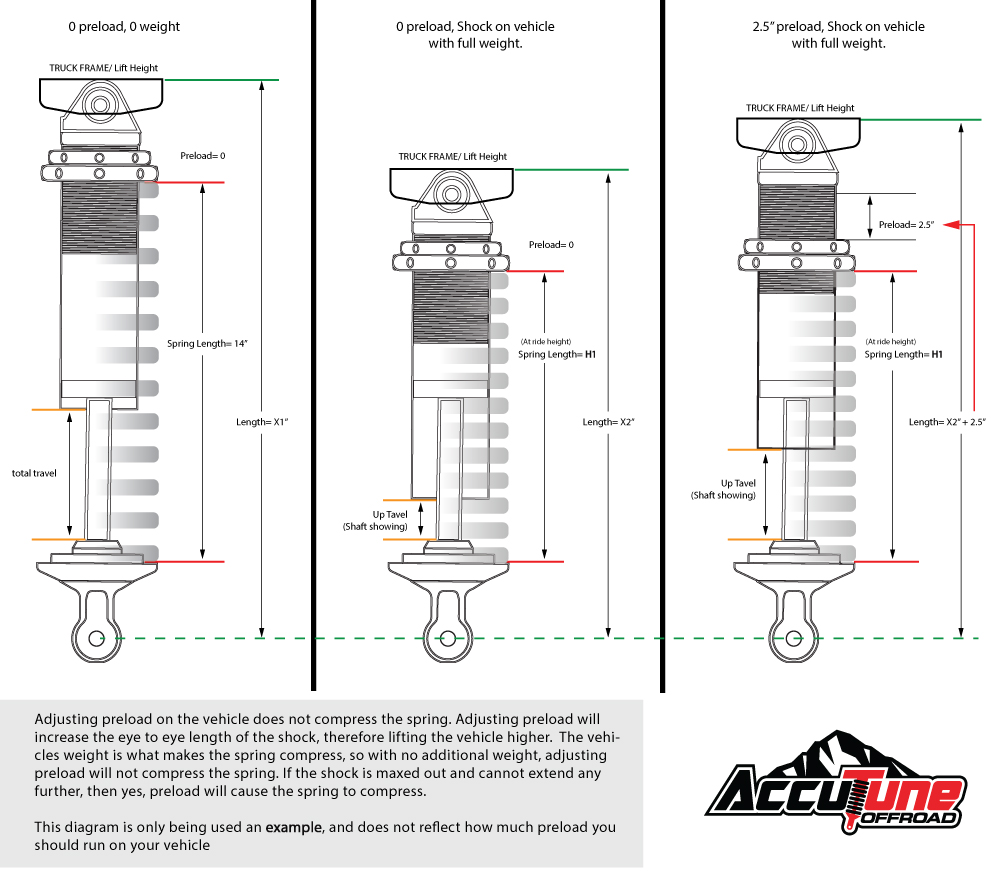
Preload is often misunderstood when it comes to suspension setup, and many people mistakenly associate it with a harsh ride. Preload refers to the amount of tension applied to the spring by adjusting the position of the spring perch. Increasing preload simply raises the ride height by compressing the spring slightly, but it does not make the ride rougher.
The key point to remember is that increasing preload only affects the vehicle’s ride height, not the spring’s compression force. A harsh ride only occurs if you set the ride height too high and don’t allow enough down travel, or if the spring runs out of travel before the suspension bottoms out. In these cases, the suspension can’t properly absorb impacts, leading to a jarring, uncomfortable ride.
To maintain optimal ride quality, it’s important to set the preload at a level that gives you the desired ride height while ensuring there is enough travel in the suspension to properly handle rough terrain and prevent bottoming out.

Compensating for Soft Valving
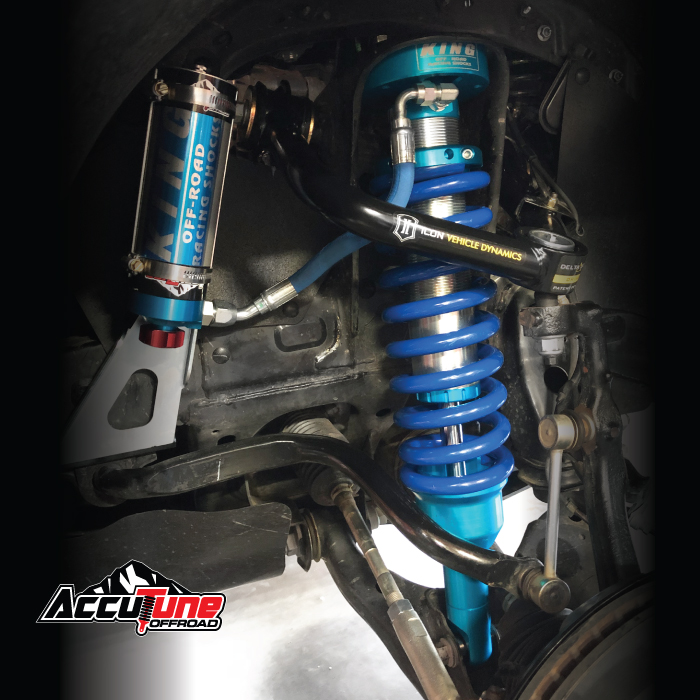
Fox, King, and other OEM front coilovers for Tacomas and 4Runners are often valved too soft straight from the factory, leading to undesirable ride characteristics. These shocks can bottom out on small drop-offs, resulting in a jarring impact, and may bounce up and down on freeway rolling bumps, creating an uncomfortable driving experience.
Some people attempt to solve this issue by adding stiffer springs to compensate for the softness. While this can somewhat improve the situation, it often creates new problems, such as increased ride harshness or reduced overall suspension travel. A stiffer spring doesn’t address the underlying issue—the shock valving.
The proper solution is to tune the coilovers to match the weight of your vehicle. This involves adjusting the shock’s damping to handle the weight of any modifications or added gear, ensuring better control, comfort, and ride quality. Custom tuning of the coilovers allows for a smoother, more controlled ride that avoids bottoming out and minimizes bouncing, while still handling the vehicle’s weight and driving conditions effectively.
More Lift Height?
It’s a common misconception that swapping to a heavier rate coilover spring will automatically lift your truck more than the standard spring. In reality, ride height is primarily achieved by adjusting the preload on the spring, not by changing to a heavier rate spring.
Before you consider swapping to a heavier spring, it’s important to ensure that the spring rate is appropriate for your truck’s total weight. A heavier rate spring might not necessarily give you the ride height you’re looking for—it could actually make the ride stiffer or cause other handling issues. Often, what you actually need to do is add more preload to the existing spring to achieve the desired ride height.
So, rather than jumping straight to a heavier spring, it’s a good idea to first check if adjusting preload on your current setup will give you the lift you need. If additional weight or modifications are causing the suspension to sag, then a heavier spring may be necessary, but it’s important to match the spring rate to your vehicle’s weight to maintain ride quality.
Why do we recommend soft springs on Tacoma’s?
Vehicles with softer springs typically provide a smoother, more comfortable ride, akin to a Cadillac. This is because softer springs compress more easily from ride height, allowing the tire to extend downwards more quickly to follow the terrain, which makes them more responsive to bumps and uneven surfaces. As a result, softer springs tend to absorb impacts better and deliver a more comfortable ride, especially on rough terrain.
On the other hand, heavier springs are stiffer and harder to compress. This stiffness can cause more vibrations to be transmitted into the chassis, leading to a rougher ride. Tacoma’s and 4Runners with springs that are heavier than necessary won’t offer as smooth a ride on the road. You’ll likely feel more feedback from small bumps, and when it comes to large bumps or hits, the heavy springs may be too stiff, resulting in a jarring, jolting feeling.
Finding the right spring rate for your vehicle’s weight and your driving style is crucial. Too heavy a spring will compromise ride quality and comfort, while too soft a spring may not provide the necessary support for your vehicle’s load or driving conditions. The goal is to find a balance that keeps the vehicle responsive to terrain while maintaining comfort.
How soft can we go?
The ideal spring rate for a smooth ride often falls between 450 to 550 lb/in, as softer springs generally provide a more comfortable, Cadillac-like ride. However, there are practical limitations that prevent such soft springs from being feasible on Toyota Tacoma and 4Runner coilovers. The primary limitation is the available space for the spring, as most OEM fit coilovers for mid-travel Tacomas and 4Runners can accommodate a maximum spring length of 14 inches.
To make matters more complex, the amount of shock travel and the necessary preload to achieve the desired ride height play a key role in determining the appropriate spring rate. When it comes to achieving a reasonable balance between comfort and functionality, 600, 650, and 700 lb/in springs are typically the only viable options in a 14” length that can fit within the given space and still provide the required performance.
Ultimately, despite the desire for softer springs, it turns out that 600 lb/in springs are the softest option that will still function properly within the constraints of the suspension setup. This is likely why 600 lb/in springs are commonly used as the standard on most aftermarket 2.5 coilovers for the Tacoma and 4Runner. These springs offer a compromise between comfort and capability, providing a smoother ride without sacrificing too much performance.
*Preload = (spring free length) – (spring length when shock is fully extended)
Why tune your shocks instead of installing heavy springs?
Shocks are indeed velocity-sensitive, meaning they respond to how quickly the suspension moves, making them much more tunable than springs. Shocks can adjust to varying terrain conditions, including small bumps, large impacts, slow rolling bumps, and quick, hard hits. This makes them a critical component in fine-tuning suspension performance for a more controlled and comfortable ride.
When using advanced tuning techniques like AccuTune Double Flutter Stacks, you gain an added layer of responsiveness, allowing the shock valving to react more specifically to the characteristics of different bumps. Double Flutter Stacks help optimize the shock’s ability to absorb both small, repetitive bumps and larger, high-speed impacts by adjusting the flow of oil through the shock in a more nuanced way.
Fixing issues with soft shock valving should focus on adjusting the internal components of the shock, such as the pistons, shims, and valving stack, rather than relying solely on external adjustments. Internal tuning addresses the root cause of the problem, ensuring that the shock is set up to perform as needed across various terrains, without causing issues like bottoming out or excessive harshness.
By carefully tuning the shock’s internal valving, especially with technologies like double flutter stacks, you can achieve a much smoother ride without sacrificing off-road performance. This allows you to fine-tune your suspension for the best ride quality while maintaining the durability and control necessary for tough off-road conditions.
Spring Rate Recommendations for 2-2.5” lift:
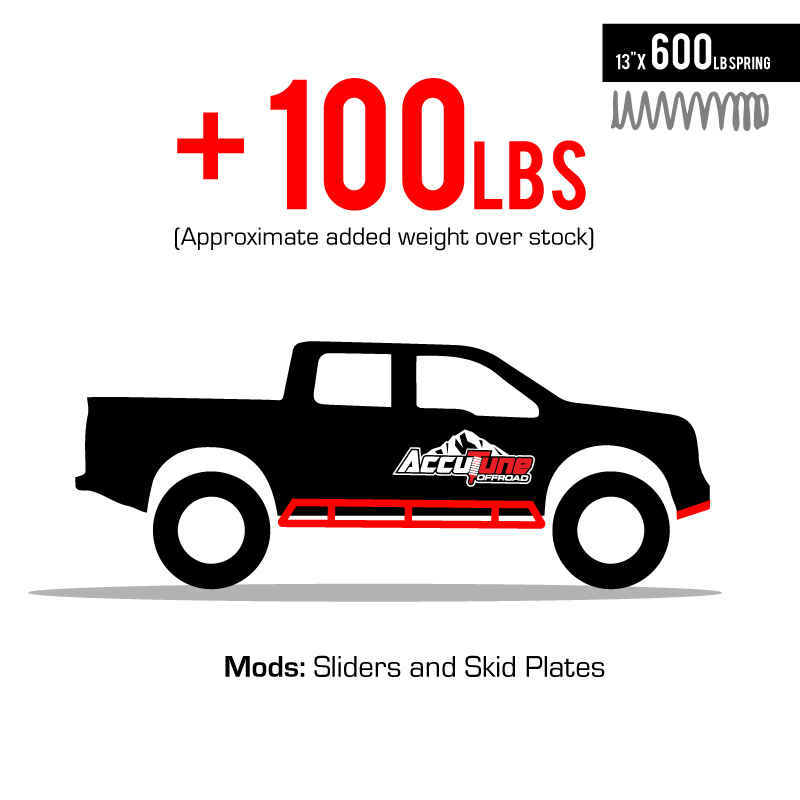
13” x 600 lb/in Spring:
Standard on:
-2.5 Fox Factory Race Series Coilovers – Tacoma
Possible added weight modifications: sliders, skid plates.
Min installed length: 11” 1
(max preload = 2″)
14″ x 550lb Spring:
Standard on:
-2.5 King Coilovers – 2003-2024 4Runners
-2.5 Ride Coilovers – 2005-2015 Tacoma/2003-2009 4Runner
Possible added weight modifications: sliders, skid plates.
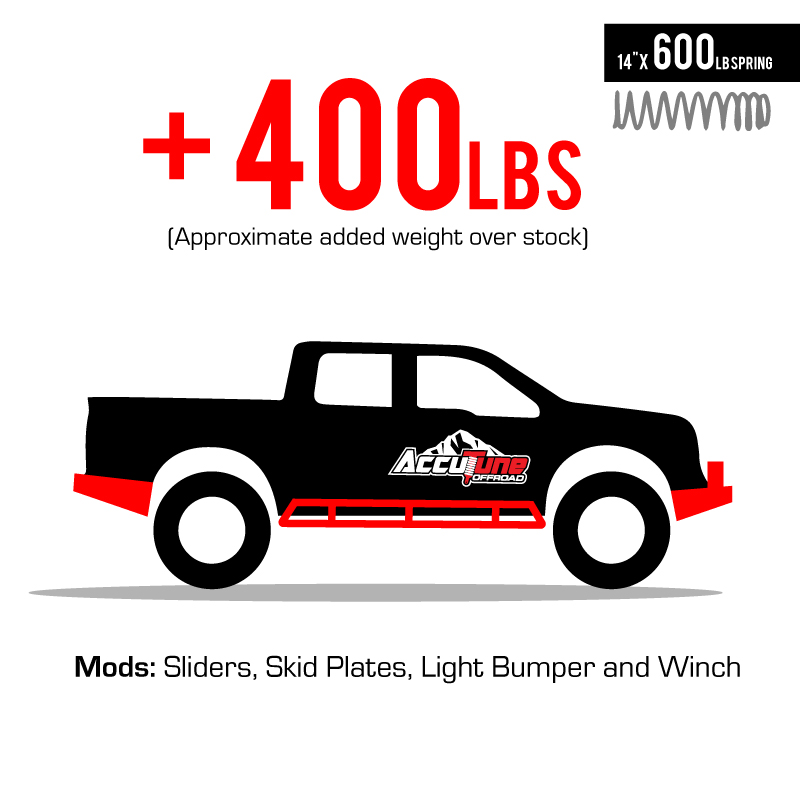
14” x 600 lb/in Spring:
Standard on:
-2.5 Fox Factory Race Series Coilovers – 03-24 4Runner
-2.5 Fox Performance Elite Series Coilovers – 05-23 Tacoma & 03-24 4Runner
-2.5 King Coilovers – 05-23 Tacoma
-2.5 Ride Coilovers – 2016-2023 Tacoma & 2010-2024 4Runner
Possible added weight modifications: sliders, skid plates, light bumper, & light winch.
-Min installed length: 11-3/8” 1
(max preload = 2 5/8″)
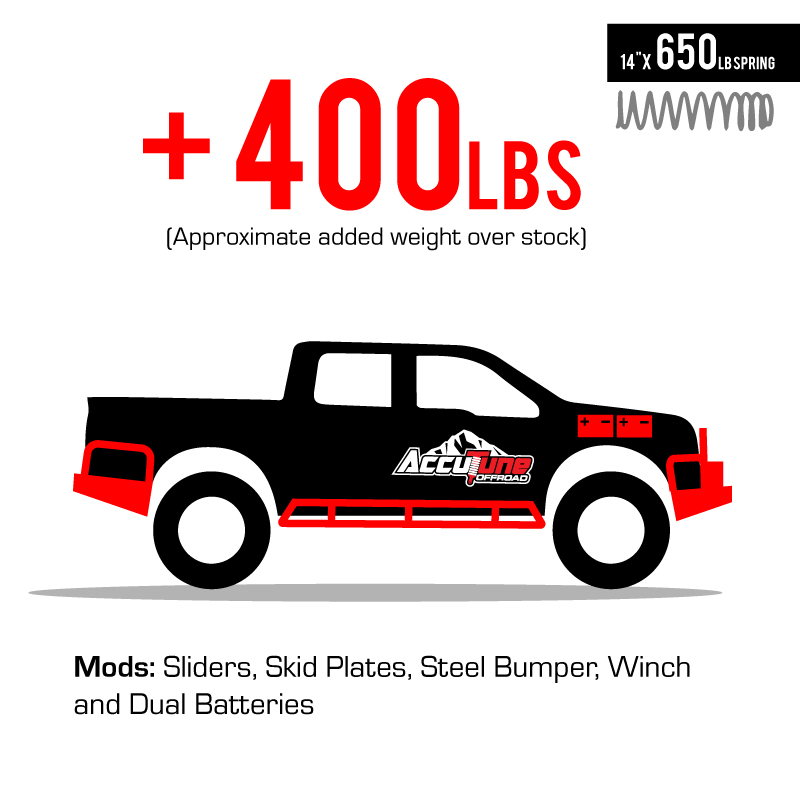
14” x 650 lb/in Spring:
Optional on:
-All Fox, King & Ride Shocks
Possible added weight modifications: sliders, skid plates, steel bumper, winch, dual batteries
Min installed length: 11-3/4” 1
(max preload = 2 1/4″)

14” x 700 lb/in Spring:
Optional on:
-All Fox, King & Ride Shocks
Possible added weight modifications: sliders, skid plates, steel bumper, winch, dual batteries, bed rack, roof top tent, additional armor.
Min installed length: 11-3/4” 1
(max preload = 2 1/4″)
*Min installed length: Minimum length the spring can be with the shock fully extended before risk of coil bind.
13” spring data not available, extrapolated between 12” & 14”, use at own risk
All data based on Fox shock and Eibach spring data, use at own risk
Summary:
While heavier 650 and 700 lb/in springs are needed for heavily loaded Tacomas and 4Runners to achieve that extra 2+ inches of lift, they can lead to undesirable ride qualities on vehicles closer to stock weight. These heavy springs often result in a rough, bouncy ride that doesn’t handle smaller bumps or uneven terrain well, causing the suspension to feel harsh and uncomfortable.
As you’ve noted, the solution to this issue isn’t just changing the springs, but re-valving the shocks. By adjusting the shock’s internal valving (using techniques like AccuTune’s Double Flutter Stacks), the suspension can be fine-tuned to handle the forces of the spring more effectively. This re-valving process addresses the bounce and undulating motion that heavy springs can cause, ensuring a smoother ride.
For most stock weight or lightly loaded Tacomas and 4Runners, a 600 lb/in spring is a great choice. It offers a good balance between lift and ride quality. Of course, spring rates are highly vehicle-specific, and AccuTune Off-Road can help with more precise rate calculations and recommendations based on your vehicle’s specific weight and usage.
Reaching out to AccuTune for personalized advice will help ensure you’re selecting the ideal spring rate to maximize performance, comfort, and durability, especially when you’re pushing the limits off-road or carrying extra gear.
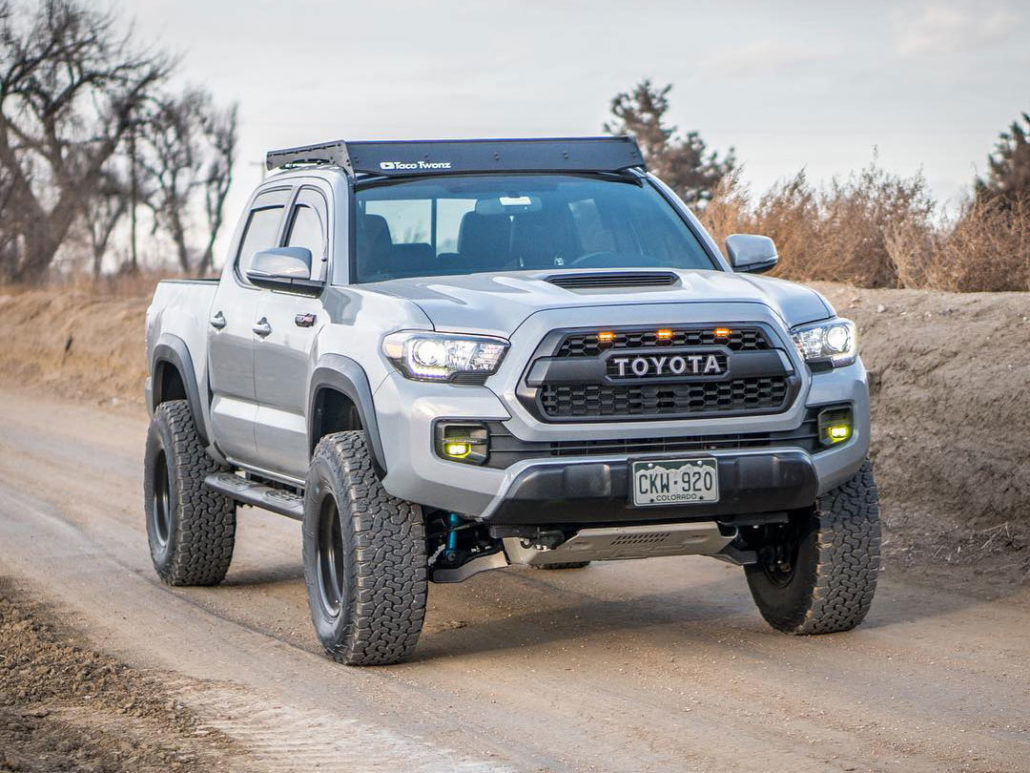






Would the 14″x 600 be a good way to go on achieving the lift I want plus get a better ride quality. My current FOX 2.5 is set at 2.5″ top threads to lock ring, rides like a OBS Ford… Even with my sway bar taken off. Thanks!
Ride quality will mostly come from the internal valving, not so much the spring. We specialize in tuning coilover shocks and can definitely help the shocks perform better than they currently do. Please give us a call to discuss options for your truck and driving style. (424) 377-0808
Will going from a 13 inch 600lb spring to a 14 inch 600lb spring give me the same 2.5 lift on fox 2.5 stock weight tacoma with less preload on the coil over?
If you’re keeping the same spring rate, you will need the same amount of preload to get the same lift height. A longer spring will show less threads. If you’re maintaining the stock weight, I would suggest keeping the 13×600 springs.
Would like to level or small lift but want to keep smooth ride no offroading just for looks 2018 SR5 4X4 4 DOOR YOUR SUGGESTIONS PLEASE THANKS MARK
Hey Mark, give us a call and we can offer some recommendations. 424-377-0808
I was doing a needle barring and CV axle upgrade over the weekend and noticed that both Eibach coils that came with my Fox coil overs were broken(looks to be discontinued) in bottom part of the coil. Looking over the site and measuring the coils at full droop 14″ 600 lbs coil look to be to long? I am planning on a winch (because I already own it) with a hidden mount behind the the cover. Would I loose ride quality with this one upgrade if I were to just replace the 14″ 600 lbs and adding the winch. I do lots of high speed desert running during coyote season. (below freezing temps)
We should look more into why those springs broke and then look into spring rate options. Shoot us an email to discuss Sales@AccuTuneOffroad.com
I’ve got a 3rd Gen Taco. 150lb full hoop steel bumper, 100lb steel sliders, prinsu roof rack, diamondback bed cover with 3 steel Bed bars 100lbs, and 250lb roof top tent. That’s current normal Rolling weight. For suspension- Fox 2.5 DSC w/ resi In front and 2.0 dsc w/ resi in the rear with icon rxt leaf pack. Plan to do full aluminum skids and a winch. I take it off-road and push it hard on the trails. I’d like to keep a decent ride on the street but functional off road and have 2.5-3” max lift.
Question is should I go up to a 14” 650 or 700 coil in the front?
Really appreciate what you do for this community and look forward to sending in shocks when it’s time for rebuild.
Sounds like you will have upwards of 600lbs of added weight to the truck, which would fit into that 14″ x 700lb spring category. Since you plan to add a winch and more accessories that would probably be a good option. If you are looking to purchase new suspension from us, we can calculate spring rates for you before buying.
I currently have King 2.5 coilovers with 3.14.700 springs and have arb under protection arb steel bumper + synthetic rope winch. No sliders. I run my shocks at 6 clicks tire pressure 29psi and the ride feels stiffer and i tend to feel potholes on road and at slow uneven offroad the vehicle seems to move quite a lot. Will 650 LB rate solve my issue?
Tacoma or 4Runner? 700lb spring does sound a bit too stiff for just a steel bumper and winch. However, the shock valving will play an even stronger role in your ride quality issue.
Its a tacoma, but fast offroad at 70 miles in not that bad, and at snails pace (offroad) the vehicle jolts and moves a lot, will 650lbs 14” still be good at higher speeds (over 60mph) and as well as at slow offroad.
650 solved the issue at very slow speeds on uneven surfaces chasis vibrations on rough roads are gone & rides well, i havr increased the compressionadjusters. 650 way better than the 700lbs springs
I have a 2016 Tacoma offroad and got it used with I think a 3in spacer lift to run 285/55/17 tires but want to add a synthetic line winch and a hidden winch mount that looks like together will prolly weigh about 100lbs what do I need to do to keep my current lift from sagging? Thanks
Spacer lifts are usually installed with a stock coilover shock, which you cannot replace the spring. We do not recommend coilover spacers at all, so our recommendation would be to replace the spacer and stock coilover with a coilover shock that can be adjusted and have the spring replaced to a heavier rate spring. We have several Fox and King options to choose from here:
https://accutuneoffroad.com/product-category/vehicle-specific-products/toyota/tacoma/toyota-tacoma-2020-2005/front-shocks/
What would you recommend if I’m looking to maintain the factory shocks but gain 1-2″ of lift on a 2021 TRD Pro 4Runner? The challenge seems to be that the lower spring perch is not flat on these TRD Fox shocks (Front).
For any additional lift height over stock, we would not recommend keeping the factory shocks & coilovers. I would suggest taking a look at our complete kits.
https://accutuneoffroad.com/product-category/vehicle-specific-products/toyota/4runner/toyota-4runner-2017-2010/10-4runner-mid-travel-suspension-kits/
2016 4Runner Trail
C4 Slimline Bumper w/10k winch
Steel Skid Set 3pc
RCI Sliders
King 2.5 on 650lb springs – just installed and having quite a bit of understeer and moderate bump steer. Previously on Icon 2.5 but unsure of spring rate and had no issues like this. I feel like the preload was adjusted too high or maybe my spring rate is too much? Doesn’t make sense. At highway speeds turning right it feels like it wants to roll over, turning left is almost normal.
I would get an alignment done, that should solve your issue.
Hi there,
I have a 2018 4runner trying to get the King 2.5 kit. I’m getting the rear OME 898 400lb spring and not sure should I get 600 or 700 spring for the front. Planning to go center steel bumper with winch, fridge and swing out with spare at the back. Also has RTT right now. Seems not much in the front. Please advise. Thanks
Alex
We would need to get an approximate total weight being added to the vehicle in order to recommend a specific spring rate up front. Once you have those numbers and ready to order, our sales team can run some numbers in our calculator to confirm and get you dialed in. Please email Sales@accutuneoffroad.com when you are ready to proceed
I have a2005 4Runner with 280 lbs of weight between sliders skids bumper and winch, just got some fox .5 dsc with the 600 lb 14” springs, looking for a ball park figure of preload for 2.5 inches of lift so I can be close to the height when I first put them in
Unfortunately I dont have a way to calculate that exact number for you. You can try to take measurements now, so you have a reference point after you install the new coilovers. Once you install the new coilovers and get them settled you can reference this article to help determine how much preload adjustment will be needed for your desired ride height. Just keep in mind that 2.5″ lift height may exceed our recommended shock lengths at ride height and can affect ride quality.
I just did the archive garage kit with fox 2.5 x 14. I currently have icon coil overs. I need to switch spings to 700s due to arb bumber and winch up front. What would be best to complement the rear setup. I was looking at the s2 kit from icon since I already have them
If you are pushing 400+ pounds of added weight, a 700 LB spring may be necessary to support that additional weight.